Events & Webinars
The Risks You Don’t See Coming Usually Leave Clues
When organizations experience a serious injury, costly claim, compliance violation, client loss, quality issue, or unexpected turnover, the aftermath often sparks the same conversation:
“How did we not see this coming?”
The truth is that most business risks don’t appear overnight. In many cases, warning signs were present long before the incident occurred. A frustrated employee stopped speaking up. A supervisor ignored a near miss. A customer concern wasn’t escalated. Team members assumed someone else was addressing the issue. The challenge isn’t always identifying risk. It’s creating an environment where people feel comfortable surfacing concerns before they become problems.
Risk Starts With People
Organizations invest significant resources in safety programs, policies, procedures, and compliance efforts. While these tools are critical, many risks begin with human behaviors and leadership practices. Consider some common situations:
- Employees stop reporting concerns because they don’t believe anything will change.
- Supervisors become so focused on productivity that important conversations are delayed.
- Communication breaks down between departments.
- Small process failures become normalized over time.
- Team members hesitate to challenge decisions or ask questions.
None of these circumstances immediately create a crisis. But together, they can create the conditions where larger issues take root.
The Leadership Connection
Frontline leaders are often the first line of defense against organizational risk. They are closest to daily operations, employee concerns, customer interactions, and emerging challenges. Their ability to recognize patterns, encourage communication, and build trust often determines whether issues are addressed early or left to grow. Strong leaders don’t just solve problems. They create an environment where problems are identified sooner. This means:
- Encouraging open dialogue.
- Listening without defensiveness.
- Taking concerns seriously.
- Following through on commitments.
- Creating accountability at every level.
When employees trust their leaders, they are more likely to report concerns before they escalate.
Small Signals Matter
Many organizations focus attention on major incidents. However, valuable lessons can often be found in the smaller signals that occur beforehand. A near miss can reveal a safety gap.
An employee complaint can expose a communication breakdown. A customer concern may highlight a process issue that affects others. A missed deadline may indicate broader operational challenges. Organizations that consistently examine and address these early indicators are often better positioned to prevent more significant problems later.
Building a Culture That Surfaces Risk
Effective risk management isn’t solely the responsibility of safety professionals, HR teams, operations leaders, or executives. It requires a culture where communication flows freely and concerns are welcomed. Organizations that excel in this area typically:
- Encourage honest conversations.
- Respond constructively to feedback.
- Empower employees to speak up.
- Hold leaders accountable for building trust.
- Treat early warning signs as opportunities to improve rather than assign blame.
When people feel heard, organizations gain visibility into risks before they become costly incidents.
Join the Conversation
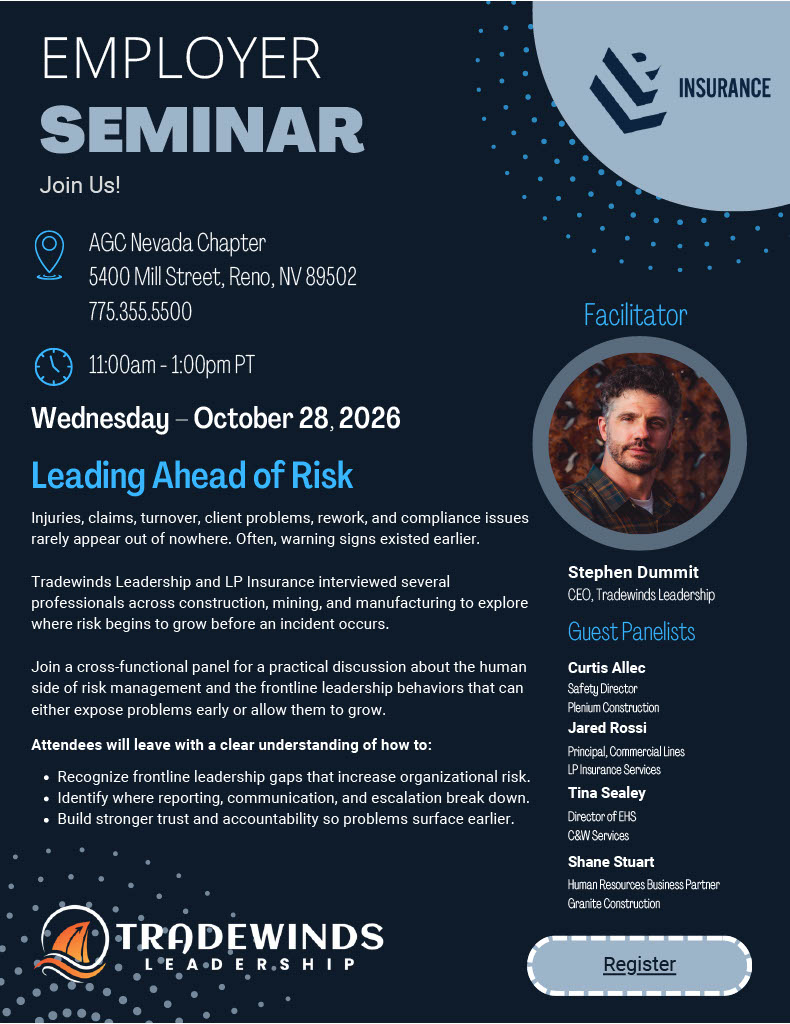
These themes will be at the center of our upcoming seminar, Leading Ahead of Risk, where industry leaders from construction, mining, manufacturing, safety, HR, and insurance will discuss where risk begins, how warning signs are missed, and what leaders can do to identify issues sooner. The discussion will explore practical strategies for recognizing leadership gaps, strengthening communication, and creating accountability that helps organizations prevent problems before they escalate. Because the best time to address risk is often long before it becomes a headline, claim, injury, or compliance issue. The clues are usually there; the question is whether we’re prepared to recognize them.
Leading Ahead of Risk will take place on Wednesday, October 28, 2026, from 11:00 a.m. to 1:00 p.m. PT at the AGC Nevada Chapter in Reno.
Location: AGC Nevada Chapter, 5400 Mill Street, Reno, NV 89502.
Register for Leading Ahead of Risk | View the seminar invitation LP Seminar Leading Ahead of Risk
Explore LP’s HR Consulting and Risk Management services, or contact your LP advisor about your organization’s priorities.
Frequently asked questions
When and where is Leading Ahead of Risk?
Wednesday, October 28, 2026, 11 a.m. to 1 p.m. PT, at the AGC Nevada Chapter, 5400 Mill Street, Reno, NV 89502.
Who is this seminar for?
The cross-functional discussion is relevant to leaders in construction, mining, manufacturing, safety, HR and insurance who want to recognize organizational risks sooner.
How do I register?
Use the registration link above to RSVP through the event’s official Microsoft form.