Risk & Safety
Understanding Your Experience Modification Rating: How to Take Control of Workers’ Comp Costs
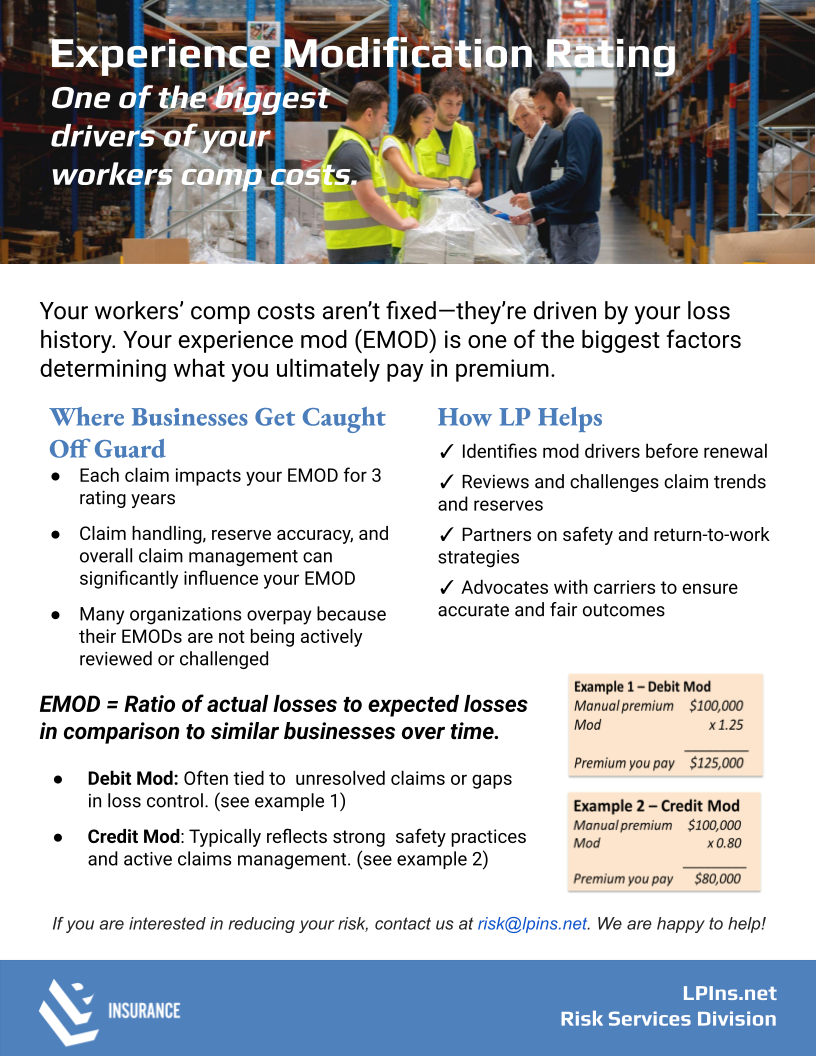
One of the biggest drivers of your workers’ comp costs isn’t fixed—it’s driven by your loss history.
At LP Insurance, we take our role as guardians seriously. Since 1927, our employee-owned team has focused on protecting what you’ve built and the communities you serve. When clients ask why their workers’ compensation premiums keep climbing, the answer often lies in a metric they haven’t actively managed: the Experience Modification Rating (EMOD). Your workers’ comp costs aren’t fixed—they’re driven by your loss history, and your EMOD is one of the biggest factors determining what you ultimately pay in premium.
What Is an Experience Modification Rating?
The EMOD is essentially a ratio of your actual losses to expected losses in comparison to similar businesses over time. This rating acts as a multiplier on your manual premium—meaning a high EMOD can dramatically increase what you pay, while a low EMOD rewards strong safety and claims management with meaningful savings.
When organizations fail to manage this rating, they often end up overpaying because their EMODs are not being actively reviewed or challenged. Understanding the difference between a debit and credit mod is the first step toward taking control:
- Debit Mod: Often tied to unresolved claims or gaps in loss control. For example, if your manual premium is $100,000 and your mod is 1.25, the premium you pay becomes $125,000.
- Credit Mod: Typically reflects strong safety practices and active claims management. For example, if your manual premium is $100,000 and your mod is 0.80, the premium you pay drops to $80,000.
Where Businesses Get Caught Off Guard
Many businesses assume that once a claim is filed, the process is out of their hands. This misconception can be costly. Organizations frequently get caught off guard in several key areas:
- Long-Term Impact: Each claim impacts your EMOD for three rating years, meaning a single incident has a long tail of financial consequences.
- Claim Management Influence: Claim handling, reserve accuracy, and overall claim management can significantly influence your EMOD. If reserves are set too high and left unchallenged, your rating suffers.
- Lack of Active Review: Many organizations overpay simply because their EMODs are not being actively reviewed or challenged for accuracy.
3 Ways to Take Control of Your EMOD
1. Prioritize Workplace Safety
The most effective way to improve your EMOD is to prevent claims from happening in the first place. Invest in safety training, conduct regular hazard assessments, and create a culture where employees feel empowered to report concerns before they become incidents.
2. Implement a Return-to-Work Program
When injuries do occur, having a structured return-to-work program reduces claim duration and overall costs. Modified duty assignments keep employees engaged and productive while they recover, which directly impacts the financial weight of each claim on your EMOD.
3. Actively Monitor and Challenge Reserves
Claim reserves—the estimated cost of a claim—directly affect your EMOD calculation. If reserves are set too high or aren’t adjusted as claims develop, your rating suffers unnecessarily. Regular reserve reviews with your broker and carrier ensure accuracy and fairness.
What Insurers Look For
- Loss Trends: Are your claims frequency and severity improving, stable, or worsening over time?
- Safety Programs: Do you have documented safety protocols, training records, and incident investigation procedures?
- Claims Management: Are you actively involved in managing open claims, or are they left to develop without oversight?
- Return-to-Work: Do you have a formal program that brings injured employees back to productive work as quickly as possible?
Quick Wins You Can Put in Place This Month
- Request a copy of your current EMOD worksheet and review it for accuracy.
- Verify that all closed claims are reflected correctly in the rating calculation.
- Schedule a reserve review meeting with your carrier or TPA for all open claims.
- Document your return-to-work program and communicate it to supervisors.
- Identify your top loss drivers and create targeted safety initiatives to address them.
How LP Helps
At LP Insurance, relationships come first. We don’t just place coverage; we actively partner with you to manage the factors driving your costs. Our Risk Services Division takes a proactive approach to your Experience Modification Rating:
- Pre-Renewal Analysis: We identify mod drivers before your renewal, giving you time to address issues and potentially reduce your premium.
- Reserve Reviews: We review and challenge claim trends and reserves to ensure they accurately reflect the exposure—not inflated estimates.
- Safety Partnerships: We partner with you on safety and return-to-work strategies to mitigate future losses and build a stronger safety culture.
- Carrier Advocacy: We advocate with carriers on your behalf to ensure accurate and fair outcomes throughout the claims process.
Download the Printable Flyer
Use our one-page Experience Modification Rating flyer to validate your approach and brief stakeholders. It distills the essentials your insurer expects and the steps that reduce both risk and cost.
Let’s Protect What You’ve Built
If you’re interested in reducing your risk and taking control of your workers’ compensation costs, our Risk Services Division is ready to help. You don’t have to navigate complex rating formulas alone.
Connect with our team or contact us at risk@lpins.net to start actively managing your EMOD today.
FAQs
What is a good Experience Modification Rating?
An EMOD of 1.0 is considered the industry average. A rating below 1.0 (a credit mod) means your loss experience is better than average, resulting in a premium discount. A rating above 1.0 (a debit mod) means your loss experience is worse than average, resulting in a premium surcharge.
How long does a workers’ comp claim affect my EMOD?
Each claim typically impacts your Experience Modification Rating for three consecutive rating years. This long-term impact makes proactive safety and active claims management essential for controlling costs over time.
Can an Experience Modification Rating be changed or challenged?
Yes. Errors in payroll reporting, incorrect job classifications, or inaccurate claim reserves can all artificially inflate your EMOD. Our team regularly reviews and challenges these factors to ensure your rating is accurate and fair.