HR Alerts
Important Labor Law Updates You Need to Know
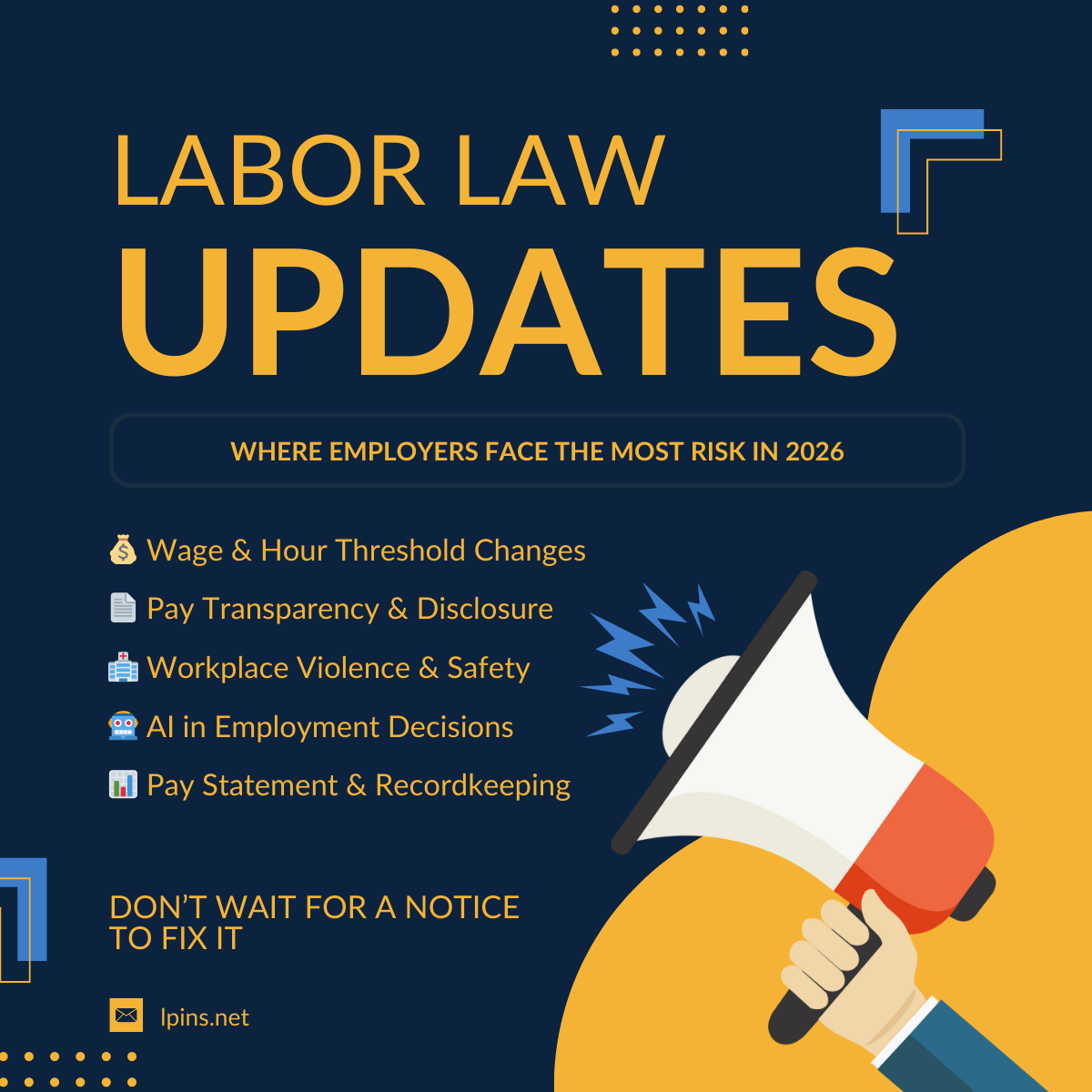
Every year, labor laws evolve at the state and local levels. Below is a summary of key compliance changes that your business should be aware of in Nevada, California, Arizona, New Mexico, and Oregon
Don’t wait until deadlines are looming—partner with LP Insurance Services now to ensure a compliant and successful year. For more information, please contact the LP HR Consulting Team.
2026 Labor Law Updates
Nevada
SB 260 – Wildfire Smoke Exposure Mitigation
Employers with outdoor workers must implement communication and safety protocols to mitigate exposure to dangerous air quality levels caused by wildfire smoke.
Arizona
Statewide Minimum Wage
Minimum wage increases to $15.15 per hour.
(Local jurisdictions may require higher rates.)
New Mexico
Statewide Minimum Wage
Minimum wage increases to $17.00 per hour.
(Local jurisdictions may require higher rates.)
Oregon
SB 426 – Liability for Construction Wage Compliance
Makes property owners and prime contractors jointly and severally liable with subcontractors for unpaid wages on covered construction projects.
SB 1108 – Expansion of Paid Sick Leave Qualifying Reasons
Adds leave eligibility for blood donation connected with a voluntary program approved or accredited by the American Association of Blood Banks or the American Red Cross.
SB 906 – Pay Statement Requirements
Employers must provide new employees with detailed information regarding itemized pay statements, including:
- All payroll codes used for pay rates and deductions, with a detailed description or definition of each code
- A comprehensive list of all pay rates employees may be eligible for
- All benefit deductions and contributions
- Every type of deduction that may apply
- The purpose of deductions made during a regular pay period
- Any allowances claimed as part of minimum wage
- Employer-provided benefits that may appear as contributions or deductions
SB 537 – Workplace Violence Protections for Health Care Workers
Strengthens workplace violence prevention requirements in healthcare settings, including planning, reporting, and training obligations.
California
Statewide Minimum Wage
Minimum wage increases to $16.90 per hour.
(Local jurisdictions may require higher rates.)
SB 642 – Pay Transparency
Employers must provide a good-faith salary or hourly wage estimate that an employee will earn starting on the first day in the position when requested by an applicant or employee.
Employers with 15 or more employees must post a position’s pay scale in all job postings. The posted scale must accurately reflect compensation beginning on day one.
SB 642 – Equal Pay Act Updates
Prohibits pay disparities between employees of another sex.
Broadens the definition of wages to include all forms of compensation, including bonuses, allowances, hotel accommodations, and reimbursements.
SB 294 – Workplace Know Your Rights Act
Employers must provide an annual notice to all employees and upon hire outlining key workplace rights.
Employers must notify an employee’s emergency contact if the employee is arrested or detained at work.
SB 513 – Personnel Records
Current or former employees must be provided education and training records upon request. Records must include:
- Employee name
- Training provider name
- Duration and date of training
- Core competencies covered (including equipment or software skills)
- Resulting certification or qualification
AB 316 – Artificial Intelligence
Employers are prohibited from claiming AI autonomously caused harm in employment-related actions.
AB 406 – Crime Victim Leave
Expands unpaid leave protections for employees who are victims of certain crimes, or whose family members are victims.
Labor Code Section 515 – Minimum Salary Requirements
Minimum salary for overtime-exempt executive, administrative, or professional employees increases to $1,352.00 per week.
Minimum hourly rate for physicians and surgeons paid hourly increases to $107.17.
Compensation thresholds for overtime-exempt computer professionals increase to:
- Annual salary minimum: $122,573.13
- Monthly salary minimum: $10,214.44
- Hourly rate minimum: $58.85
AB 774 – Creditor Garnishment Withholding
Employers must begin withholding 30 days after receiving a creditor garnishment order.
If the employee files a claim of exemption and the employer has actual notice by the close of business on the 29th day after receiving the order, withholding is extended. In that case, withholding must begin 45 days after the employer receives the claim materials.
Employers must document and provide:
- The date the employee was given a copy of the withholding notice and order
- The name and title of the individual who provided the notice
- A brief description of how the notice was delivered
Several additional states, including Colorado, Illinois, New York, and Washington, are implementing new 2026 labor and employment laws. Multi-state employers should review jurisdiction-specific obligations to ensure compliance across their full operational footprint.
Please reach out to our LP HR Consulting Team with any questions. We are here to help protect your team and your business continuity.