Risk & Safety
Southern Nevada Construction Is Growing Fast—So Are the Risks
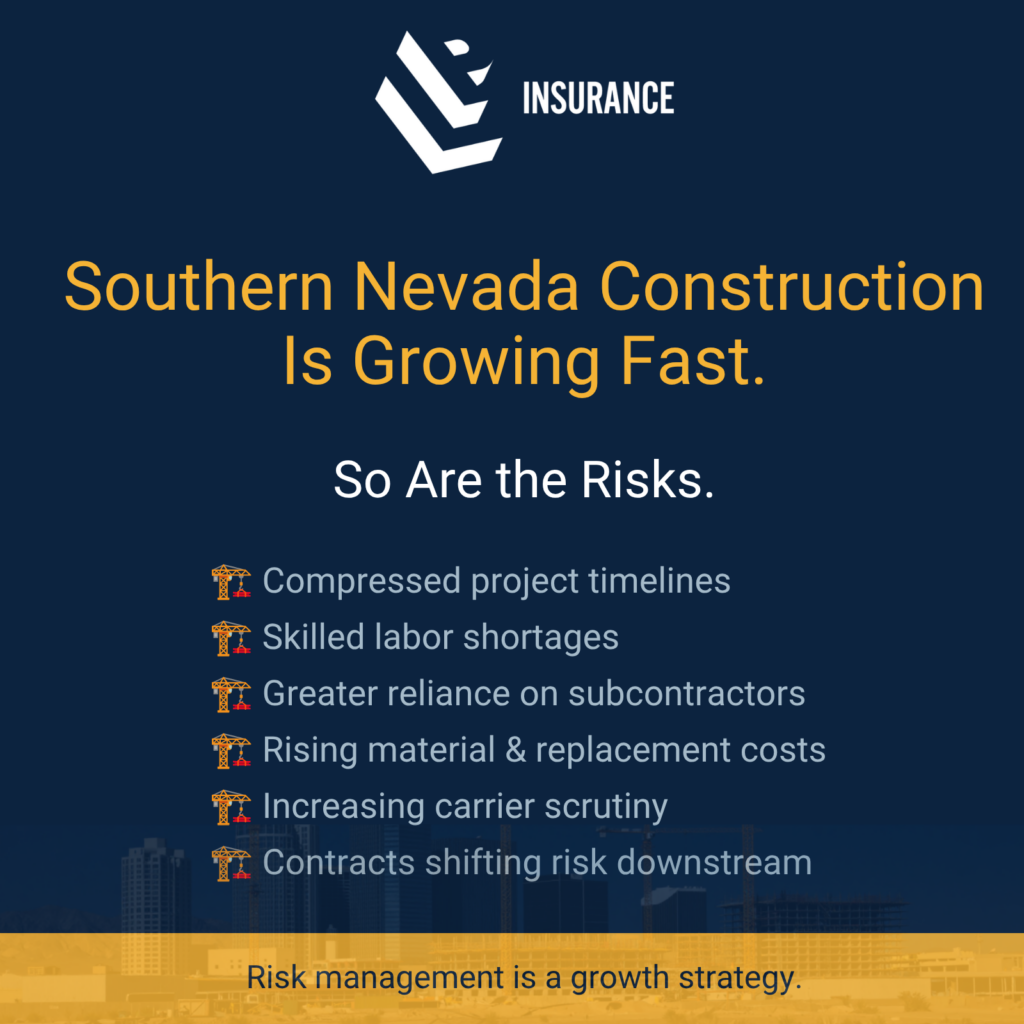
Southern Nevada’s building momentum shows no signs of slowing. From resort reinvestment on the Strip and industrial expansion in North Las Vegas and Henderson to healthcare, water, and transportation projects, construction activity continues at a strong pace. Growth brings opportunity—and pressure. Timelines compress. Labor is tight. Subcontractor networks stretch. Materials and replacement costs keep climbing. Carriers are scrutinizing safety, documentation, and loss history. And contracts are often written to push more risk downstream. In this environment, risk management is more than an insurance discussion. It’s a business continuity and growth strategy.
What We’re Seeing Across Southern Nevada Construction
- Compressed project timelines and liquidated damages concerns
- Skilled labor shortages and turnover
- Greater reliance on subcontractors and multi-tier subs
- Rising material, equipment, and replacement costs
- Increased carrier scrutiny on safety culture, documentation, and claims history
- Contracts shifting more risk downstream to GCs and specialty trades
From Insurance to Operational Resilience Firms best positioned for long-term success are investing in resilience—not just backlog. That starts with practical steps across safety, people, contracts, partners, and coverage.
Strengthen Safety Culture and Leading Indicators
- Use leading indicators (near-miss reports, JSAs completed, safety observations, corrective actions closed) alongside lagging metrics (TRIR, DART, EMR).
- Standardize pre-task planning, toolbox talks, and stretch-and-flex. Document consistently—photos, attendance, and sign-offs matter at claim time.
- Empower foremen with simple checklists for high-risk tasks (excavation, tie-off, lockout/tagout, hot work).
- Conduct periodic third-party site audits to validate and demonstrate commitment to carriers.
2) Level Up Fleet Safety
- Implement telematics/cameras for coaching, not just enforcement. Target harsh braking, speeding, and seatbelt use.
- Formalize driver selection and MVR review cadence; train on work-zone driving unique to Las Vegas corridors and night work on I‑15/215.
- Maintain DOT files and preventive maintenance schedules; document everything to strengthen claims defensibility.
3) Hire, Retain, and Protect Your Workforce
- Tighten onboarding and site orientation, especially for short-duration hires and temp labor.
- Cross-train and upskill to reduce production bottlenecks; use mentorship to retain apprentices.
- Coordinate HR and Safety on post-injury response plans to manage medical direction, return-to-work, and reduce WC costs under Nevada’s system.
4) Manage Subcontractor Risk—Before Bid Day
- Prequalify subs: financials, EMR, TRIR, NV OSHA history, references, insurance (limits, endorsements, carriers), and written safety programs.
- Require certificates plus key endorsements: additional insured (CG 20 10 & CG 20 37 or equivalents), primary and noncontributory, waiver of subrogation, completed ops.
- Verify subcontractor agreements don’t dilute risk transfer through conflicting terms or inadequate limits, and avoid “pay-when-paid” pitfalls tied to safety obligations.
5) Review Contracts Proactively
- Watch for broad indemnity, duty to defend, heightened warranty language, and uncapped LDs.
- Align insurance requirements with realistic market capacity; negotiate mutual waivers of consequential damages where possible.
- Coordinate with counsel; your broker should map insurance endorsements to the contract’s promises to avoid uninsured obligations. This is not legal advice.
6) Align Coverage With Evolving Project Exposures Construction insurance should scale with project complexity and delivery method:
- General Liability and Excess/Umbrella: Right-size limits for resort/hospitality exposures, public interfaces, and crane/heavy lift operations.
- Workers’ Compensation (Nevada): Manage classification accuracy, audit prep, and mod improvement plans.
- Commercial Auto: Rising verdicts and repair costs demand strong Auto and XS; telematics can support better pricing and claims outcomes.
- Builder’s Risk and Installation Floater: Address escalation clauses, testing, flood/water intrusion, equipment breakdown, and soft costs/time element.
- Professional Liability/Contractors E&O: Design-assist/Design-Build and value engineering increase professional exposure.
- Pollution/Environmental: Silica, mold, and demolition/abatement work often require standalone coverage.
- Cyber: Project management platforms and connected equipment introduce exposure beyond the trailer.
- Wrap-Ups (OCIP/CCIP): For complex or multi-phase jobs, wraps can standardize limits, improve claims control, and reduce disputes—evaluate feasibility early.
7) Claims Readiness and Documentation Discipline
- Establish a jobsite incident protocol: immediate care, scene control, photos/video, witness statements, and supervisor report within 24 hours.
- Centralize documentation: training records, toolbox talks, equipment inspections, and subcontractor certificates/endorsements.
- Hold quarterly claim reviews with your broker and carrier to spot trends and adjust training or procedures.
8) Cost Control in a Hardening Market
- Market intelligently—not constantly. Use underwriter meetings, stewardship reports, and demonstrated improvements to earn credits.
- Consider deductibles/retentions you can operationally manage; pair with robust loss control to protect TCoR.
- Explore alternative risk and wrap strategies where size and loss profile support it.
A Practical Checklist for Project Teams
- Safety: Leading indicators tracked weekly; audits scheduled; high-risk checklists in use.
- Fleet: Telematics active; MVR reviews current; PM logs complete.
- Workforce: Onboarding/orientation documented; RTW plan ready.
- Subcontractors: Prequalification completed; COIs and endorsements verified; contracts consistent.
- Contracts: Indemnity and insurance terms reviewed; legal and broker alignment complete.
- Coverage: Limits and forms aligned to project; builder’s risk scope confirmed; wrap feasibility assessed.
- Claims: Site protocol posted; documentation habits enforced; quarterly reviews set.
Common placements include GL and Excess/Umbrella, Workers’ Comp, Commercial Auto, Builder’s Risk/Installation Floater, Contractors Pollution, Professional/Contractors E&O, and, where appropriate, wrap-ups (OCIP/CCIP). Cyber is increasingly relevant for connected jobsite tech.
Prequal subs for safety/financial strength, require proper AI/PNC/waiver endorsements, verify limits and carriers, and align contract indemnity with your insurance. Track COIs and endorsements, not just certificates.
An Owner-Controlled Insurance Program is sponsored by the owner; a Contractor-Controlled program is sponsored by the GC/CM. Both consolidate project insurance to standardize coverage and centralize claims. A feasibility study early in planning determines the fit.
Underwriters look closely at loss history, safety culture and documentation, fleet controls, subcontractor management, and contract practices. Demonstrable leading indicators and consistent documentation can materially improve underwriting outcomes.
Why LP Insurance
Our role is more than placing coverage. We help contractors protect their ability to keep building, keep hiring, and keep growing. We pair local market understanding with experienced advocacy—walking shoulder to shoulder with clients to prepare for what’s ahead and respond when it matters.
Let’s Build Resilience Together
If you lead a construction business in Southern Nevada and want a candid assessment of your operational and insurance program, our construction team is here to help.
- Request a risk and insurance alignment review
- Ask for our subcontractor prequalification and contract review checklist
- Schedule a claims and safety documentation audit Contact: Southern Nevada Construction Practice | LP Insurance Disclaimer: This content is for general informational purposes only and is not legal advice. Consult qualified counsel for contract matters.