Risk & Safety
Workers’ Comp: Indicators That Warrant a Closer Look
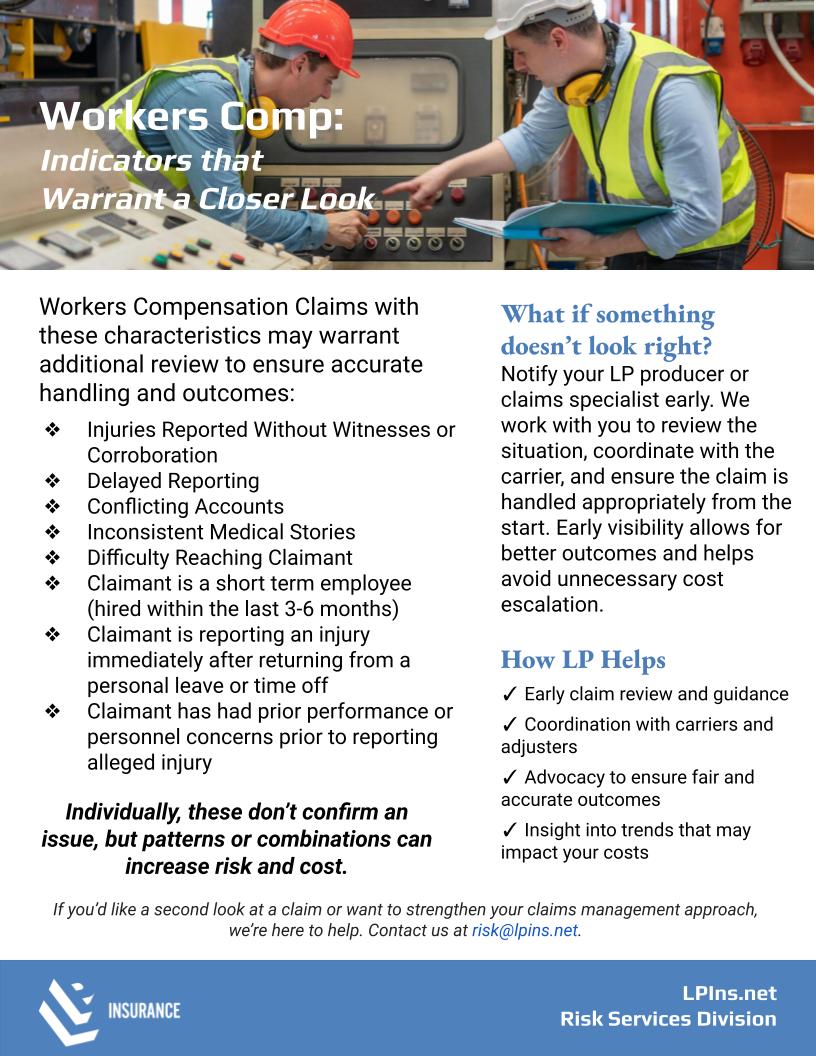
Workers’ compensation fraud costs the industry up to $44 billion each year.
For nearly a century, LP Insurance Services has stood as a guardian for businesses and the communities you serve. Since 1927, our employee-owned team has believed that relationships come first. When an employee is injured on the job, providing prompt and appropriate care is the priority. However, managing workers’ compensation effectively also means protecting your organization from unnecessary cost escalation and potential fraud.
Why identifying claim red flags matters
Most workers’ compensation claims are legitimate, but problematic claims can have a disproportionate impact on your bottom line. Early identification of suspicious patterns allows for timely investigation and intervention. This proactive approach helps ensure fair outcomes for genuinely injured workers while safeguarding your business from fraudulent or exaggerated claims that drive up premiums.
Indicators that warrant a closer look
Workers’ compensation claims with the following characteristics may warrant additional review to ensure accurate handling and outcomes:
- Injuries reported without witnesses or corroboration
- Delayed reporting of the injury or incident
- Conflicting accounts of how the injury occurred
- Inconsistent medical stories that don’t align with the described incident
- Difficulty reaching the claimant for follow-up or investigation
- Short-term employees (hired within the last 3-6 months) filing claims
- Injuries reported immediately after returning from personal leave or time off
- Prior performance or personnel concerns documented before the alleged injury
Individually, these don’t confirm an issue, but patterns or combinations can increase risk and cost.
3 ways to strengthen your claims review process
1. Establish immediate reporting protocols
Create a clear, well-communicated policy requiring all workplace injuries to be reported immediately. Train supervisors to document incident details comprehensively while evidence and memories are fresh. Delayed reporting is one of the most common red flags, and a strong reporting culture reduces this risk significantly.
2. Document everything consistently
Use standardized questionnaires and incident report forms to capture the who, what, when, where, and how of every workplace injury. Consistent documentation makes it easier to identify discrepancies and provides a solid foundation for any subsequent investigation.
3. Look for patterns, not isolated incidents
A single red flag does not confirm fraud or misrepresentation. However, when multiple indicators appear together in a single claim, the combination warrants a closer look. Train your team to recognize these patterns and escalate appropriately rather than dismissing individual warning signs.
What if something doesn’t look right?
Notify your LP producer or claims specialist early. We work with you to review the situation, coordinate with the carrier, and ensure the claim is handled appropriately from the start. Early visibility allows for better outcomes and helps avoid unnecessary cost escalation.
How LP helps
At LP Insurance, relationships come first. Our Risk Services Division partners with you to manage workers’ compensation claims proactively and effectively. Our support includes:
- Early claim review and guidance — We help you assess claims from day one.
- Coordination with carriers and adjusters — We serve as your advocate throughout the process.
- Advocacy to ensure fair and accurate outcomes — We push for results that protect your interests.
- Insight into trends that may impact your costs — We identify patterns before they become costly problems.
Download the printable flyer
Keep these indicators top of mind for your management team. Download our Workers’ Comp: Indicators That Warrant a Closer Look flyer (PDF) and share it with your supervisors and HR team.
Let’s protect what you’ve built
If you’d like a second look at a claim or want to strengthen your claims management approach, we’re here to help. Connect with our team or contact us at risk@lpins.net to get started.
FAQs
What is a red flag in a workers’ compensation claim?
A red flag is an indicator or characteristic that suggests a claim may need additional review. Examples include injuries without witnesses, delayed reporting, conflicting accounts, and claims filed by short-term employees. While a single red flag doesn’t prove fraud, combinations of indicators increase the likelihood that further investigation is warranted.
Should I deny a claim if I see red flags?
No. Red flags are not evidence of fraud — they are signals that additional review may be appropriate. The goal is to ensure accurate handling and fair outcomes, not to deny legitimate claims. Contact your LP producer or claims specialist early so we can help you navigate the situation properly.
How can early intervention reduce workers’ comp costs?
Early intervention allows you to gather accurate information while details are fresh, coordinate with carriers before costs escalate, and identify potential issues before they become expensive problems. Studies consistently show that even modest delays in claim management can significantly increase total claim costs.